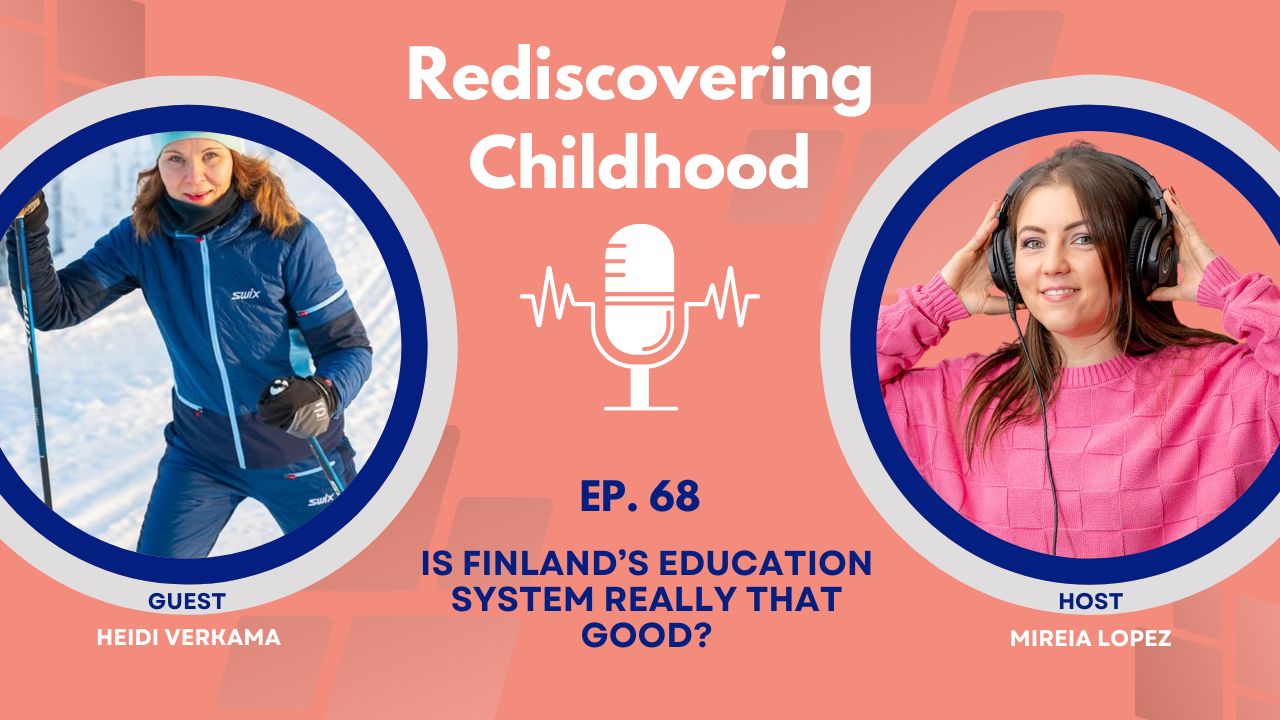
Ep68 Is Finland's Education System Really That Good?
Is Finland's Education System Really That Good?
What Finland's Schools Can Teach Us About Raising Happier, More Confident Children.
Discover how Finland's trust-based education system, 45-minute learning cycles, and play-based learning approach can transform child development.
If you've ever felt like your child is exhausted, overscheduled, and struggling to concentrate, you're not alone. Many parents and educators are asking the same question: is there a better way?
In the latest episode of Rediscovering Childhood, host Mireia Lopez sits down with Heidi Verkama, a primary school teacher in Finland who specialises in Swedish and English. Heidi pulls back the curtain on a system that consistently produces some of the world's most curious, confident, and well- adjusted learners.
🎧 Listen to the full episode here.
It All Starts with Trust
When Mireia asked Heidi what makes Finnish education so effective, she didn't talk about test scores or technology. She talked about trust.
"I think the most important thing is that in Finland, education is based on trust," Heidi explains. "Everybody trusts the system. Teachers trust that parents support learning at home. Parents trust that teachers genuinely care. And children trust that school is a safe place where they belong."
This culture of mutual trust creates something that's surprisingly rare: a system where nobody is busy blaming everyone else. Teachers aren't undermined by parents. Parents aren't anxious about what's happening in the classroom. And children, caught in the middle in so many other systems, are free to simply learn.
When we model trust in teachers and school, we give our children permission to feel safe there too.
The 45-15 Rule: Why Every Child Needs a Break
One of the most talked-about features of Finnish schooling is its rhythm: 45 minutes of structured learning followed by a 15-minute outdoor break. Every single hour of the school day.
To many parents and educators, this might sound like lost learning time. In reality, it's the opposite.
"When children know a break is coming, they can contain themselves a little longer," Mireia observes. "It actually builds their concentration and self-regulation, they push themselves just a little further because they know rest is coming."
Heidi agrees, noting that movement during breaks directly supports the ability to focus afterwards. Children with attention difficulties benefit especially. And there's a practical bonus: those outdoor breaks mean kids are accumulating physical activity throughout the day without anyone even noticing.
This is a principle that applies at home too. Rather than expecting children to focus for hours at a time, building in regular breaks, especially ones that involve movement or free play, can make homework time, creative projects, and even family dinners feel less like a battle.
Play Is the Most Important Work of Childhood
Perhaps the most transformative insight from this episode is one that Finnish educators treat as common sense: play-based learning isn't a break from development, it is development.
This is grounded in how the brain actually works. Before children can master complex skills like reading, writing, and abstract thinking, they need to develop their motor skills, social awareness, and emotional regulation, all of which happen naturally through play.
Finnish children spend their early years in daycare learning to tie shoelaces, use scissors correctly, throw and catch a ball, and navigate friendships. By the time they start school at age seven, they arrive not just academically ready, but confident, because they trust themselves to manage challenges independently.
For parents worried about keeping up with academic milestones, this is an important reframe. Supporting your child's play isn't indulging them, it's investing in the neural foundations that everything else is built on.
Starting School at Seven: What Happens Before That?
Finland's formal schooling doesn't begin until age seven, a full year or two later than in many countries. Here's how the journey looks:
Ages 0-6 Optional daycare, focused on play, independence, and social skills
Age 6 Compulsory preschool (approximately 4 hours per day), often located within school buildings so children begin to feel comfortable in that environment
Ages 7-12 Primary school, around 18 hours per week (roughly 4 hours per day), taught primarily by one classroom teacher who knows each child deeply
Ages 13-15 Secondary school, 30 hours per week with subject-specific teachers
Ages 16-18 Vocational college or upper secondary school leading to A-levels
The entire 12-year journey is completely free, including hot lunches for every child every day, a practice introduced after World War II on the principle that a hungry child cannot learn.
Continuous Assessment Over High-Stakes Tests
In Finland, children are not streamed, ranked, or subjected to high-stakes examinations. Instead, the system relies on continuous, formative assessment, and crucially, it teaches children to assess themselves.
"I always include self-evaluation," Heidi explains. "I ask them: how did you manage? What are you good at? What could you improve? What would you like to do next?"
This approach cultivates one of the most valuable life skills there is: self-awareness. Children learn to identify their own strengths, acknowledge where they need support, and take ownership of their growth.
Heidi also makes a point of telling children at the start of every lesson what they'll be doing and why. At the start of the year, she shares the curriculum, so students understand the whole picture. This predictability, she says, creates the same sense of safety as the 45-15 rhythm; children can focus and engage because they know what's coming.
5 Things You Can Take From This Episode Today
Whether you're a parent, teacher, or both, here are five practical tools inspired by the Finnish approach to child development:
Build in regular movement breaks. Even at home, 45 minutes of focused activity followed by 10–15 minutes of free movement can transform a child's ability to concentrate.
Protect time for unstructured play. Resist the urge to schedule every moment. Free play is where children practise social skills, build resilience, and consolidate what they're learning.
Model trust in the adults around your child. When children hear you speak respectfully about their teacher, they feel safer at school.
Encourage independence early. Let children dress themselves, carry their own bag, make small decisions. The confidence this builds is the foundation of lifelong learning.
Celebrate self-awareness, not just achievement. Ask your child not just "how did you do?" but "what are you proud of?" and "what would you like to get better at?"
The Bigger Picture
What Finland ultimately offers isn't a set of techniques; it's a philosophy. One that says children are capable, that play matters, that trust is the foundation of learning, and that slowing down is not falling behind.
As Heidi puts it: "I think if kids could change one thing, they'd ask us to please slow down."
That's an invitation worth taking seriously.
🎧 Listen to the full conversation with Heidi Verkama on Rediscovering Childhood, available now on Spotify.
This episode is proudly sponsored by: MAIA Purposeful Play, a business that offers sensory play sessions for families, schools and events, creating rich, open-ended environments where babies, toddlers and children are trusted as capable, curious learners who explore at their own pace. MAIA Build Lab is a six-week programme delivered in primary schools, using KEVA planks and the Dream Design Do approach to invite children into collaborative construction, problem-solving and creative design in line with the Irish Primary Curriculum. Find out more by clicking the links below.
🌟 MAIA Purposeful Play - https://www.maiapurposefulplay.ie/
📸 Instagram @maia_purposefulplay
🌟 MAIA Build Lab - @maiabuildlab
👥 Facebook - https://www.facebook.com/maiapurposefulplay/
Connect with Heidi Verkama:
📸 Instagram - @heidiverkama
Enjoyed this episode? Share it with a parent or teacher who needs to hear it. Every share matters.
Rediscovering Childhood is hosted by Mireia Lopez, founder of Discovery Playtime.
