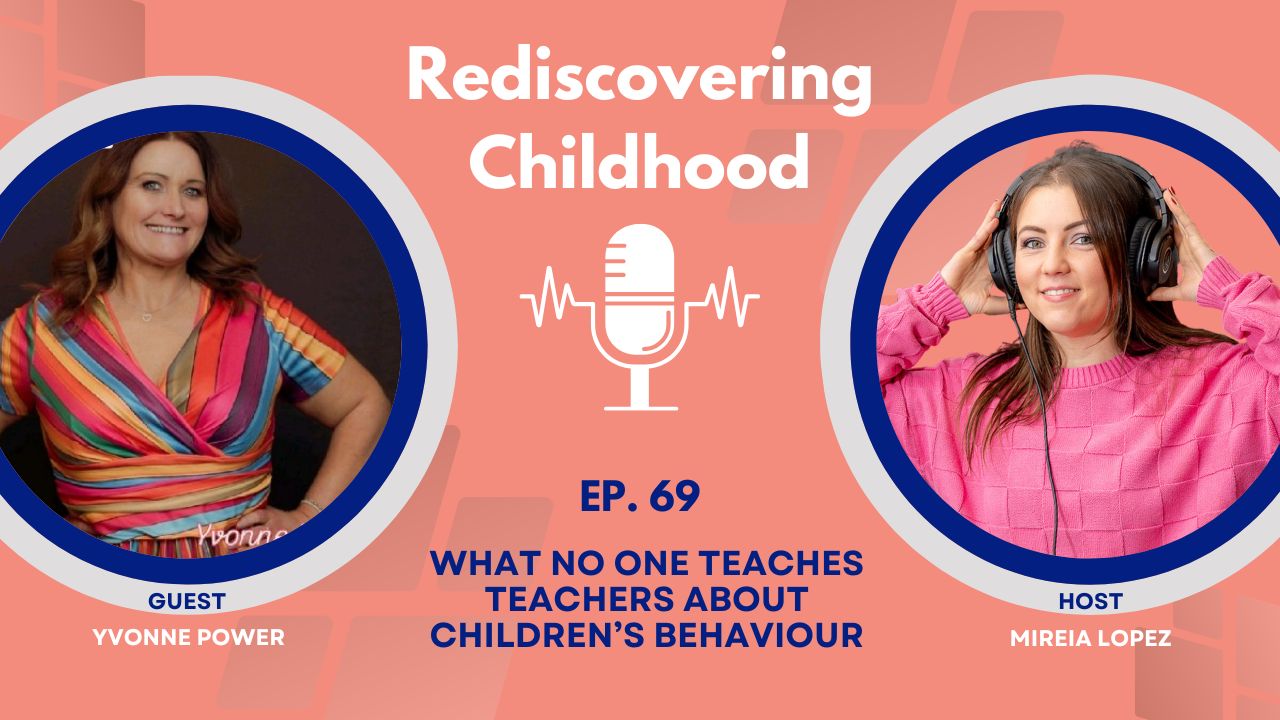
Ep69 What No One Teaches Teachers About Children’s Behaviour
What No One Teaches Teachers About Children’s Behaviour
Play therapist Yvonne Power reveals the critical gap in teacher training around attachment, self- regulation, and emotional development, and actionable changes you can make today to fill in that gap.
What if the most exhausting, confusing, and heartbreaking moments you've experienced as a teacher or parent weren't a sign that you were doing it wrong, but a sign that nobody ever gave you the right tools in the first place?
In this episode, Mireia sits down with Yvonne Power, Director of the Irish Play Therapy Community Association, accredited play therapist, certified Sand Play therapist, NLP practitioner, and Amazon number one best-selling author, to talk about what is really going on in classrooms today, and how we can start using simple tools to make positive changes.
🎧 Listen to the full episode here.
The Gap Nobody Is Talking About
Here is something to consider. The topics that define daily life in every classroom in the country; attachment, self-regulation, the nervous system, neurodevelopment, trauma, and the emotional developmental age of a child, are not standard modules in teacher training.
"These things are not covered in the training for teachers," Yvonne says plainly. "And yet they're expected to go into a classroom full of little people that are all growing and developing."
Teachers know the curriculum inside out. They were trained to deliver content, meet targets, and manage learning. But the human stuff, the complex, messy, deeply important stuff that comes in to the classroom every single morning; nobody taught them that. And when teachers who went on to train as play therapists encountered this material for the first time, Yvonne says their reaction was almost always the same: why didn't we learn this when we were training to be teachers?
This is not a criticism of teachers. It is a recognition of a structural gap that urgently needs to change, and a compassionate reminder that survival mode was never your fault.
Behaviour Is Always Communication
One of the most powerful shifts Yvonne invites us to make is deceptively simple: stop asking what is wrong with this child and start asking what is this child trying to communicate?
"When a child is acting out what they need, this is where the modules and teacher training are so important," she explains. "They can't put words on things to articulate to you how they're feeling, but they can show you."
Heidi agrees, noting that movement during breaks directly supports the ability to focus afterwards. Children with attention difficulties benefit especially. And there's a practical bonus: those outdoor breaks mean kids are accumulating physical activity throughout the day without anyone even noticing.
A child who can't stop moving, who keeps disrupting, who runs out of the classroom, who lashes out at a classmate, every one of those behaviours is a message. And when we understand what that message is, our entire response changes. Not just our words, but our tone, our body language, our nervous system, and the energy we bring into the room.
This is the foundation of conscious parenting and conscious teaching: seeing the child behind the behaviour, and asking what they need rather than simply demanding they stop.
Why Your Nervous System Is the Most Important Thing in the Room
Here is something that might feel uncomfortable, and also deeply liberating. The nervous system of the teacher is the single most powerful force in any classroom.
"We have several nervous systems in one room," Yvonne explains. "And we all get triggered by each other's nervous systems. If we don't have awareness of that, it's going to turn into a real tornado."
When a teacher is dysregulated, overwhelmed, stressed, or running on empty, every child in that room feels it. Not because children are perceptive in a mysterious way, but because co-regulation is a biological reality. We regulate each other. And if the most important adult in the room is in survival mode, the children will be too.
This is why Yvonne is passionate about teacher wellbeing not as a nice-to-have, but as a non- negotiable foundation for everything else. Teachers who are supported, debriefed, and given space to process their experiences can show up differently. And when they do, the children in their care feel the difference immediately.
Connection Before Correction: Always
One of the most practical and transformative ideas in this episode is what Yvonne calls connection before correction. And it is exactly what it sounds like.
Before we redirect, reprimand, or remove a child from a situation, we connect. We make eye contact. We use a warm tone. We name what we see: I can see it's really difficult for you to concentrate right now. What do you need?
Mireia shares her own experience of this in the episode, a child who refused to stop drawing during a Spanish lesson, and how approaching her with curiosity rather than control completely changed the moment. "She knows what she needs," Yvonne reflects. "And when you connect first, the correction can actually be heard."
The science behind this is clear. When a child feels threatened or shamed, their brain disconnects from the capacity for higher thinking. Learning becomes impossible. But when they feel safe, seen, and connected, that higher thinking brain comes back online, and so does the ability to learn, reflect, and make better choices.
Practical Tools You Can Try Today
This episode is not about adding more to an already overflowing plate. It is about small, intentional shifts that can change everything. Here are some of the practical tools Yvonne and Mireia explore:
The Message Box. Place a box in your classroom and invite children to drop in answers to: What is something you would like me to know about you? You will be amazed at what comes back, and how much easier it becomes to connect with each child when you understand what they are carrying.
Name It to Tame It. When a child seems off, name what you observe gently and without assumption: I noticed you looked down when I asked how you were. I wonder how you're really feeling? Often, that is all a child needs to open up.
The Focus of the Month. Rather than overhauling everything at once, introduce one small shift each month; more playfulness in lessons, more intentional transitions, a morning connection ritual. Celebrate what is working in staff meetings. Let teachers inspire each other.
Process Journaling. If debriefing with a colleague isn't possible, write it out. What came up for you today? What felt hard? What did you notice about a particular child? Getting it out of your head and onto paper creates the containment that teachers so desperately need.
Rhythm and Ritual. Build predictable, warm moments into your day; a greeting at the door, a grounding exercise before lessons begin, a moment of connection after lunch. Rhythm creates safety, and safety is where learning lives.
The Bigger Picture
What Yvonne leaves us with is both challenging and deeply hopeful. Every child wants to do their best. Every teacher walked into this profession because they cared. The gap between that intention and the daily reality is not a personal failing, it is a systemic one.
But within that, there is enormous possibility. Because the shifts that matter most are not complicated or expensive. They are human. They are relational. And they are available to every teacher and parent who is willing to pause, connect, and ask a different question.
As Yvonne puts it: "A teacher's words become a child's inner voice for a lifetime. So what would you like that inner voice to be?"
That is worth thinking about.
🎧 Listen to the full conversation with Yvonne Power on Rediscovering Childhood, available now on Spotify, Apple Podcasts, and YouTube.
This episode is proudly sponsored by: Little Vista, a tablet-based childcare tool that simplifies activity recording, eliminates paperwork, connects parents, and frees childcare professionals up to do what they do best…care for children! Find out more by clicking the links below.
🌟 Website - littlevista.ie
💼 LinkedIN - https://www.linkedin.com/company/crechecom/
👥 Facebook - https://www.facebook.com/LittleVista/
Connect with Yvonne Power:
📸 Instagram - @seedsofgrowthtraining
💼 LinkedIN - https://www.linkedin.com/in/yvonne-power-250405212/
Rediscovering Childhood is hosted by Mireia Lopez, founder of Discovery Playtime.
